
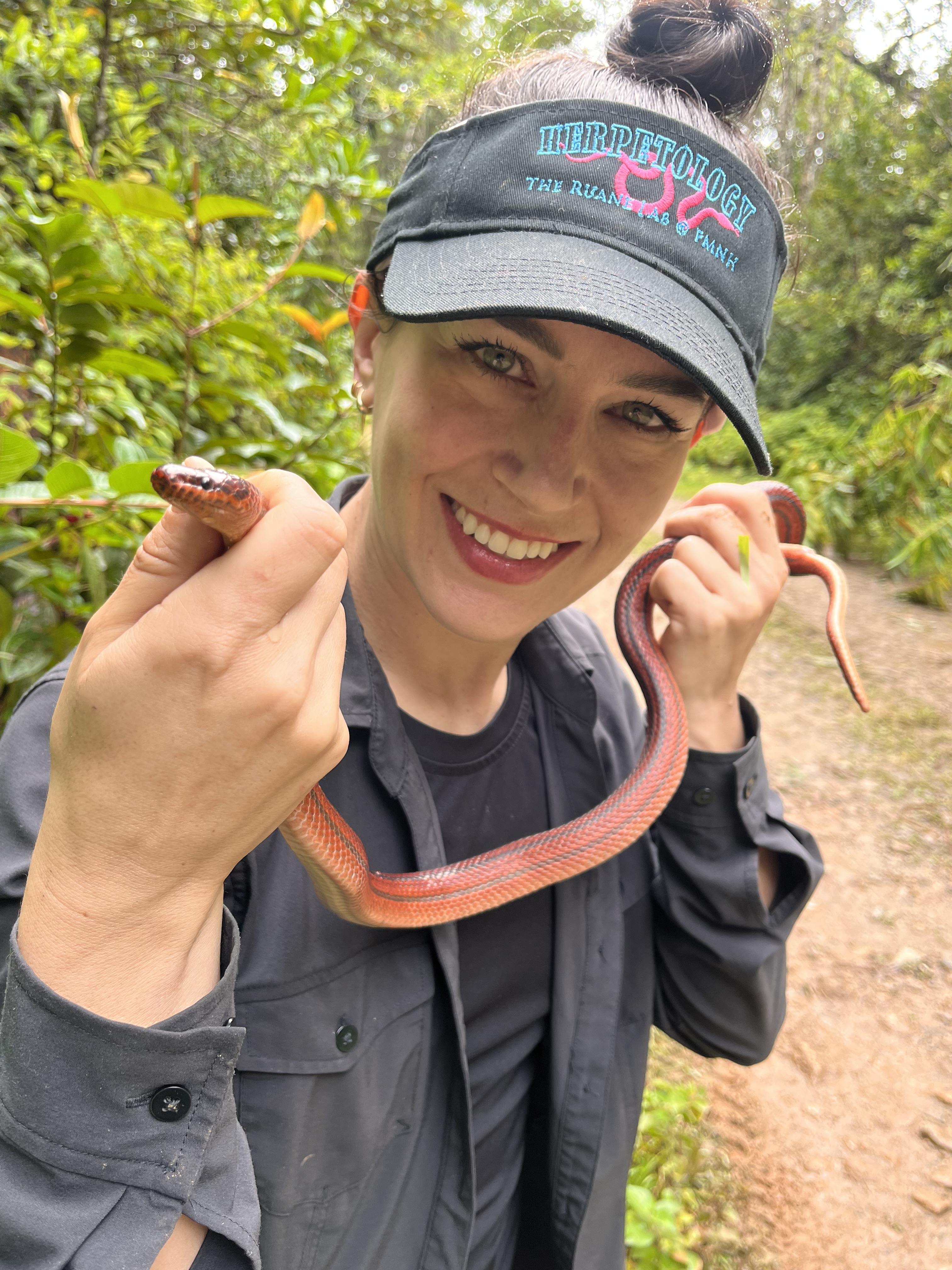
Undergraduate & Volunteer Opportunities
I receive many inquiries from undergraduates and individuals interested in volunteering or working in the Ruane Lab. At this time, I do not individually manage a standing undergraduate or volunteer program. Any internships or positions I have will be posted on the FMNH Careers and Volunteers pages listed below, and for current opportunities at the Field Museum of Natural History, please see:
Careers page:
https://www.fieldmuseum.org/landing/careers
Volunteer page:
https://www.fieldmuseum.org/landing/volunteer
You may also wish to visit the Amphibians & Reptiles (Herpetology) section of the museum website to learn more about departmental activities and consider reaching out to the other herp curator or the collection manager in Herpetology to inquire about potential opportunities.
https://www.fieldmuseum.org/science/centers-and-labs/amphibians-reptiles
Prospective Graduate Students
Thank you for your interest in joining my research group at the Field Museum of Natural History.
I work on the evolutionary biology and systematics of snakes using integrative and genomic approaches. If you are considering a Master’s or Ph.D. with me, please read the following carefully to determine whether your goals align with the focus and expectations of my lab.
What I Study
My research centers on evolutionary biology, phylogenomics, and systematics of snakes. While I am broadly interested in squamate evolution, my lab’s primary focus is on snakes and especially with respect to:
- Species delimitation and taxonomy
- Phylogenomics and comparative genomics
- Historical biogeography
- Diversification and macroevolution
- The use of natural history collections for modern research
- Integrative approaches combining morphology, genomics, and museum data
Much of our work leverages large genomic datasets, museum specimens (including historical and fluid-preserved material), and comparative methods. We frequently publish in leading journals in systematics and evolutionary biology.
What I Am (and Am Not) Looking For
I am not seeking students whose primary motivation is:
- “I love reptiles and amphibians.”
- “I want to work with cool animals.”
- “I want to handle snakes.”
Liking reptiles is wonderful and definitely part of the job! But it is not enough.
I am looking for students who have a strong background in (and passion for!) general herpetological knowledge/taxonomic knowledge and are deeply interested in:
- Evolutionary theory
- Squamate evolution, especially snakes
- Species concepts and delimitation
- Phylogenetic inference
- Comparative methods
- Writing scientific papers
- Asking and answering big evolutionary questions
If your primary goal is animal husbandry, field handling, captive breeding, wildlife rehabilitation, or general natural history without a strong evolutionary framework, my lab is probably not the best fit. I am not suited to act as the primary advisor for someone looking to work on amphibians or to conduct typical ecology or conservation biology work (although I often co-advise students with these interests).
What a Ph.D. Really Is
A Ph.D. is not extended coursework.
It is not primarily fieldwork.
It is not primarily lab benchwork.
A Ph.D. is learning how to design, execute, and publish scientific research.
You will:
- Develop independent research questions
- Analyze complex datasets
- Write manuscripts and grants
- Revise manuscripts after peer review
- Submit again
- Present your work publicly
- Write more
Ultimately, your Ph.D. will be judged by your published papers and your ability to think as an independent scientist. If you do not enjoy writing, revising, and thinking critically about data and theory, a Ph.D. may not be the right path.
Institutional Pathways
Ph.D. Students
Ph.D. students in my lab are admitted through the University of Chicago Committee on Evolutionary Biology (CEB). This multidisciplinary program emphasizes strong training in evolutionary theory, quantitative methods, and professional development.
Program information:
https://evbio.uchicago.edu/
Applicants should review the structure and expectations of the CEB program carefully before contacting me.
Master’s Students
Recent Master’s students working with me have been enrolled through:
- DePaul University (Biological Sciences Graduate Program)
https://csh.depaul.edu/academics/biology/graduate/Pages/default.aspx - Loyola University Chicago (Biology Graduate Program)
https://www.luc.edu/biology/graduateprograms/
Master’s students in my lab typically pursue genetic/genomics-based and/or systematics-focused projects designed to produce at least one publishable manuscript while receiving training in writing and analysis.
Master’s vs. Ph.D. Expectations
Master’s Students
A Master’s degree in my lab is typically:
- Focused on a clearly defined project that I have already helped outline
- Designed to produce at least one publishable manuscript
- Training-intensive in analytical methods and scientific writing
- Completed efficiently within the expected timeframe
Ph.D. Students
Ph.D. students are expected to:
- Lead multiple projects
- Publish multiple peer-reviewed papers
- Develop intellectual independence
- Mentor junior students
- Write grants and contribute to writing grants
- Engage with the museum community (attend seminars, meet with visiting scientists, engage in outreach)
- Be able to help out with lab management at times
- Engage deeply with evolutionary theory
My goal is to train scientists who are competitive for research careers in academia, museums, government agencies, or related fields.
Skills That Help You Succeed in the Ruane Lab
Students who thrive in my lab typically:
- Enjoy reading primary literature
- Write clearly and frequently
- Are comfortable with quantitative analysis
- Are willing to learn bioinformatics
- Are persistent and with some grit
- Can work independently
- Take constructive criticism seriously (and without taking it personally)
- Are punctual
- Stick to agreed upon deadlines
- Are communicative and responsive
Fieldwork may be part of your training (and is my favorite part!), but most of your time will be spent in front of a computer analyzing data and writing. I suggest downloading and reading the paper below as you consider if you want to pursue graduate school, especially a Ph.D.
Before You Email Me
If you are interested in joining the lab, please:
- Read several of my recent papers.
- Identify specific evolutionary questions that interest you based on snakes or at least squamates.
- Explain clearly how your interests align with evolutionary biology and snake systematics.
- Describe your relevant skills and future goals (especially what career is it that you see yourself in that you need a PhD for? It’s not something to just do because you’re smart and like animals and don’t know what else to do).
Final Thoughts
Snakes are extraordinary organisms for studying evolution and I am deeply driven my my love for them in my scientific pursuits. They conveniently provide powerful systems for investigating diversification, adaptation, and biogeography. But loving snakes is not the same as wanting to be an evolutionary biologist or enough to become a primary investigator, such as a professor or curator.
If you are excited about publishing rigorous, theory-driven research about snakes and other squamates and are ready to commit to the demanding, writing-intensive nature of graduate training I would be happy to hear from you!
I conduct zoom sessions to chat with prospective student starting in September each year for applicants applying to start the following fall which corresponds well with application deadlines (e.g., for a start for fall 2027, I will zoom with prospective students in fall of 2026); at that time, you will be able to sign up to schedule a chat with me here https://docs.google.com/spreadsheets/d/14Cen8PcJTrn0G3lNM52vhbrVLTzT8n-_f3X8yFB5pX4/edit?usp=sharing.
If you have questions before that, please email me, otherwise, check that link in September to find a time to talk!
 SARA'S SNAKEPIT